


What if your customers could go from “I want that” to checkout without ever leaving their favorite social app?
That’s the promise of social shopping—and it’s already a major revenue channel, with U.S. social commerce sales projected to reach $17.5 billion in 2018, according to Retail Dive.
Key Takeaways
- Pick one social shopping feature to start (product tagging, platform shops, or a limited-time drop) and build a simple campaign around a single hero product.
- Reduce friction by using native shopping surfaces (e.g., Instagram Shops, TikTok Shop, Pinterest Product Pins) so customers can browse and buy with fewer taps.
- Use social commerce to drive in-store results by targeting high-intent audiences and measuring outcomes like store visits, email signups, and revenue.
- Learn from proven plays (urgency on Snapchat, exclusivity on Instagram, and comment selling on Facebook) and adapt them to your retail calendar.
That’s a big opportunity for retailers. Just as social media leveled the marketing playing field, social commerce is giving brands both big and small a new way to capitalize on their hard-earned social media reach. And retailers are taking notice — in a 2018 Gartner L2 analysis, 66% of brands had tried out a social commerce feature in the prior year.
What is Social Commerce?
Let’s back up for a minute. What does social commerce actually mean?
Social commerce, or social shopping, is the inevitable meeting point of social media and commerce. It’s a way to streamline the buying process for customers and increase the efficacy of social media ads for brands.
Social shopping is a trend that’s been a long time coming. Both brands and social networks have been hard at work trying to find the right way to convert social media networks into a sales platform.
Consumers, for their part, are heavily influenced in their buying habits through social media — but they’ve been slower to take to social shopping. That trend is changing. In 2018, Forbes reported that as many as 30% of consumers said they’d make a purchase on major social platforms like Pinterest, Instagram, Twitter, or Snapchat. That makes it a really good time for your retail business to get in on the action.
Social Commerce Features
Social commerce and social shopping are broad, high-level terms. There are a lot of different features and capabilities social media networks offer that fall under those umbrellas. Each social platform has taken their own approach to implementing social shopping features for brands to capitalize on, and some have been more successful than others.
Here are a handful of the most popular social commerce features across the big social media networks.
“Buy” Buttons
One of the first and most popular ways to transform social media into a sales channel is the “buy now” button. Today, native shopping entry points are most commonly found through platform shopping surfaces (for example, Instagram Shops, TikTok Shop, Pinterest Product Pins, and YouTube Shopping) rather than a universal “Buy” button across every network.

These shopping entry points serve as calls-to-action (CTAs) on a brand’s social media posts and ads and typically link users to a product detail page, a native shop surface, or a checkout flow (depending on the platform and region).
Shoppable Posts and Stories
Shoppable posts and stories allow brands and users to tag specific products wherever they are within posts or “stories.” This type of social shopping expanded quickly as platforms added product tagging and in-app shopping surfaces.
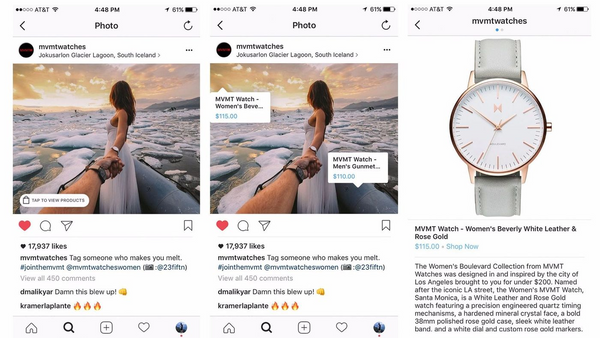
If you follow brands on either network, you may have noticed when they suddenly started prompting you to “Swipe up to learn more!” Whether it’s a post or a story, this isn’t usually a blatant advertisement. Typically, products are simply tagged within a piece of content, like the watch in the image above.
This feature enables brands to reduce friction and create a more seamless experience for customers because more of the shopping journey can stay within the social media app itself. Customers don’t have to open a new app or interrupt what they’re doing at all. That’s why it’s a popular feature, with 41% of brands giving it a try on Instagram.
Social Commerce Plugins and Apps
While the big social networks were tinkering away to find the most effective ways to implement social commerce for brands, some third parties launched their own plug-ins and apps to facilitate social shopping in the meantime.
One example of a third-party app is Soldsie. The exact set of supported channels can change over time as social platforms update their APIs and commerce policies, so confirm current compatibility directly with the vendor before you build a workflow around it.
How Can Social Shopping Grow Your In-Person Sales?
By now, you might be wondering why we’re talking about social commerce on the retail side of the multichannel sales equation. After all, many brands still make the majority of their sales out of a storefront or pop-up shop. The online share of retail has grown since 2017. For the latest quarterly breakdown, see the U.S. Census Bureau’s Quarterly Retail E-Commerce Sales release.
Drive foot traffic with high-intent audiences
But social shopping can help grow your offline sales as well. How can social commerce drive in-store shopping? For one, certain social networks give you access to a highly engaged audience with sky-high purchasing intent. Customers who are actively researching products on social media are getting ready to make a real purchase. That means if you invest in getting those people into your store, it can have a big impact on your foot traffic and sales.
Build a consistent multichannel brand experience
You’re also moving rapidly away from the days when a retail store could ignore the Internet and still thrive. Today’s consumers are looking for multichannel shopping and brand experiences. That means successful retailers have to create a cohesive and consistent brand presence across all of the platforms where customers can find them. Growing your following in any of these channels automatically boosts the others.
Turn followers into repeat in-store customers
That’s why even brick-and-mortar retailers need to emphasize building a loyal following on social media. A significant portion of consumers follow retailers on social media, and tapping into that audience can help you build a large and loyal following that will follow your brand right into your physical store.
The Best Social Commerce Options for Physical Retailers
As we mentioned before, there are several options for implementing social shopping on your brand’s social media — and more likely to be introduced. But which options are the best for retailers to leverage?

There are a few things to consider:
- Snapchat has experimented with in-app commerce experiences, including limited-time product drops and shopping-focused ad formats. That means it can be a good option for retailers looking to incorporate social shopping as an add-on to events in your store. Snapchat has long been one of the most effective platforms for location-based marketing, too, and the ephemeral nature of Snapchat content can help build exclusivity and urgency.
- Facebook remains influential when it comes to buying habits. Thirty-five percent of consumers surveyed say Facebook is an important factor in deciding which retailers to patronize. The largest social platform also has a solid reputation when it comes to driving in-store foot traffic. For example, one IKEA store in Cardiff saw a 31% lift in foot traffic from 21-25 year olds after serving up geotargeted Facebook ads.
- Pinterest users are unique from other consumers on social media in that they’re actively looking at specific products. The platform is almost more of a shopping destination than a social network. For that reason, Pinterest users can have higher buying intent and don’t mind being advertised to as much as users on other websites.
From Inspiration to Action: 3 Retailers Using Social Commerce to Their Advantage
Social commerce can help grow your retail business — but don’t just take Shopify’s word for it. Let’s look at a few retailers who are already using social shopping to their advantage.
Jordan Capitalizes on Snapchat’s Urgency
Jordan, the brand that brought you the iconic Air Jordan line of shoes, partnered with Snapchat in February 2018 to capitalize on the NBA All-Star game. Consumers within a certain radius of the arena where the game was played were able to gain access (via a special “Snapcode”) to an exclusive launch sale of the special edition Air Jordan III ‘Tinker’ shoe.

While the event brought people together, social commerce greased the wheels of the sale, making it seamless for customers to make a purchase. It’s easy to see how a feature like this could be used to draw consumers into your store.
Allbirds Taps Into Instagram’s Big Audience

If you can’t tell by now, one of the best use cases for social commerce revolves around events. Allbirds created a limited-edition collection available only on Instagram as a social-first drop (rather than tying it to a specific “30th birthday” milestone).
By doing so, they were able to reach out to Instagram’s wide audience without putting their entire product catalog on the site, and they created a sense of exclusivity because the collection never appeared on their own website.
Jenny Boston Uses Facebook to Reach New Customers
Boston-based women’s clothing retailer Jenny Boston Boutique, which hosts several boutiques across Massachusetts, made use of the third-party app we talked about above, Soldsie. Each Wednesday evening, Jenny Boston promotes a handful of products with sale prices exclusive to Facebook. They post photos and descriptions of the apparel, and all Facebook users have to do is comment “sold” to purchase them at the sale price.
In a vendor-published case study, Soldsie reported that Jenny Boston said sales increased 617% in a single month after using comment selling and Facebook ads. This result is self-reported in a marketing case study and isn’t presented as independently audited; the post also doesn’t clearly define whether “sales” refers to revenue, orders, or another metric.
The weekly sale keeps existing customers engaged and gets them excited for the Wednesday night discounts. It also introduces the brand to a new audience on Facebook, and they target those posts to consumers within a certain distance of any of Jenny Boston’s brick-and-mortar locations.
Social Commerce for Retail
While social commerce is still evolving across platforms, the technology is there. That makes it a strong opportunity for retailers of all stripes to test social-first merchandising, measure what drives store visits, and build repeatable campaigns across channels.
Next step: pick one social commerce motion (product tagging, a limited-time drop, or a live-selling event), set a clear goal (store visits, email signups, or revenue), and run a two-week test with a single hero product so you can learn quickly and scale what works.
Read more
- 4 Easy Ways to Get Better Reviews on Your Google Places Page
- Scent Marketing for Retail: 11 Strategies & Examples
- Increase Your Productivity On Instagram With These Tools for Retailers
- Affiliate Programs for Retailers: What Are They and How They Can Boost Your Revenue
- What Retailers Can Learn From The Museum Of Ice Cream’s Sweet Success
- 5 Lessons Traditional Retailers Can Learn From DTC Brands
- Retailers Who Are Nailing Facebook Live (And How You Can Too)
- What is Visual Search: How Retailers Can Use it to Enhance the Customer Experience
- Defining Social Proof: How Retailers Can Use Conformity Bias to Bolster Sales
Frequently Asked Questions
What are examples of social commerce?
- Platform shops and product tagging (for example, Instagram Shops and Pinterest Product Pins)
- Live shopping and creator-led selling (common on platforms like TikTok and YouTube)
- Shoppable ads that link directly to a product page or native checkout
- Social-first drops and limited-time launches promoted through Stories, Reels, or short-form video
- Peer-to-peer marketplaces (for example, Facebook Marketplace)
What is the most popular social commerce?
Popularity depends on what you mean by “social commerce” (marketplaces vs. in-app checkout vs. shoppable content). For peer-to-peer buying and selling, Facebook Marketplace is one of the biggest: Capital One Shopping reports that more than 1 billion people use Facebook Marketplace each month. Payment options vary by country and listing type, and many Marketplace transactions are arranged via Messenger and paid off-platform.
How do I start social shopping for my retail store?
Start with one channel and one feature (like product tagging or a platform shop), then promote a single hero product for two weeks. Set one primary goal—store visits, email signups, or revenue—and track it consistently so you can double down on what works.
Does social commerce help brick-and-mortar stores?
Yes—social commerce can drive foot traffic by reaching high-intent shoppers who are already researching products on social platforms. Use location targeting and time-bound offers (like limited drops or event promos) to give people a clear reason to visit your store.
Are there alternatives to in-app checkout for social commerce?
Absolutely—many brands use shoppable posts that link to a product page on their own site, or they run comment-selling workflows through third-party tools. Choose the approach that best matches your operational setup (inventory, fulfillment, and customer support) and the platform’s current commerce policies.
Turn Social Reach Into Sales—Online and In Store
Social shopping works best when you make buying effortless and your offer hard to ignore: use native product tagging or a platform shop to cut clicks, then add urgency with a limited-time drop or event-driven promotion. You’ll not only capture more impulse purchases—you’ll also create measurable lifts in store visits, email signups, and repeat customers.
Pick one platform your customers already use, choose one feature (tagged products, a shop surface, or a live-selling moment), and run a two-week test with a single hero product. When you’re ready to connect your social commerce campaigns to inventory, orders, and reporting, build it on Shopify so you can sell across channels with one back office—start today.

